Canada’s August GDP Stalls as Wholesale Trade Pulls Down Growth
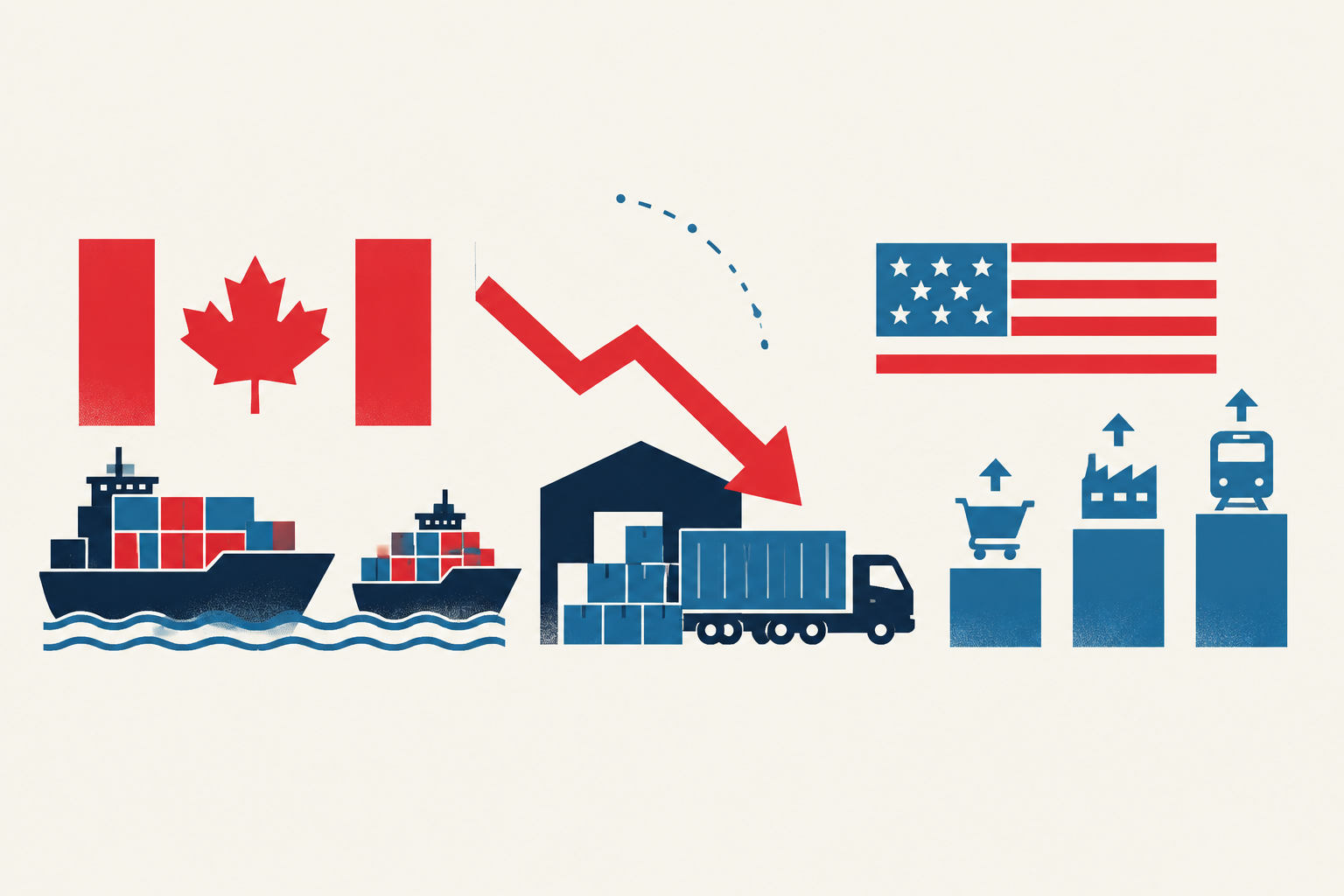
Canada’s economy recorded no growth in August, with a wholesale-trade drop offsetting gains in retail, manufacturing and transportation.
Statistics Canada’s August reading showed Canadian real GDP was unchanged for a second consecutive month, following flat month-over-month growth in July. The result was below economists’ expectation of a 0.2 per cent increase and points to slower momentum in the third quarter after a rebound in the second quarter. [1]
Wholesale trade was the largest drag, falling 1.4 per cent in August. The decline was broad across subsectors, but Financial Post reported that lower imports of passenger cars and light trucks reduced motor-vehicle and parts sales, linking the monthly slowdown directly to activity in the automotive supply and distribution chain. [1]
Some sectors provided offsets. Retail trade rose 1.2 per cent, led by a recovery at motor-vehicle and parts dealers, while manufacturing increased 0.3 per cent. Rail transportation grew 3.6 per cent and finance and insurance expanded 0.2 per cent, indicating that the flat headline GDP result reflected uneven sector performance rather than a uniform contraction. [1]
Public-sector activity also weighed on the August outcome, declining 0.2 per cent. Utilities fell 0.4 per cent as nuclear facilities in Ontario and New Brunswick underwent maintenance outages, while mining, quarrying, and oil and gas extraction were flat. [1]
The August result follows 0.4 per cent growth in June and leaves the economy on track for an estimated 1.3 per cent annualized growth rate in the third quarter based on data then available. Statistics Canada’s preliminary estimate indicated a further 0.1 per cent contraction in September, although that figure may be revised. [1]
The release is significant because two months of flat real GDP signals weaker near-term Canadian demand and business activity, while the 1.4 per cent wholesale decline was tied in part to lower passenger-vehicle and light-truck imports. The rating is not higher because retail, manufacturing, rail and financial services still expanded in August, and the September estimate remains preliminary. [1]