Lockton report flags compounding trade, fraud and benefits risks for Canadian businesses
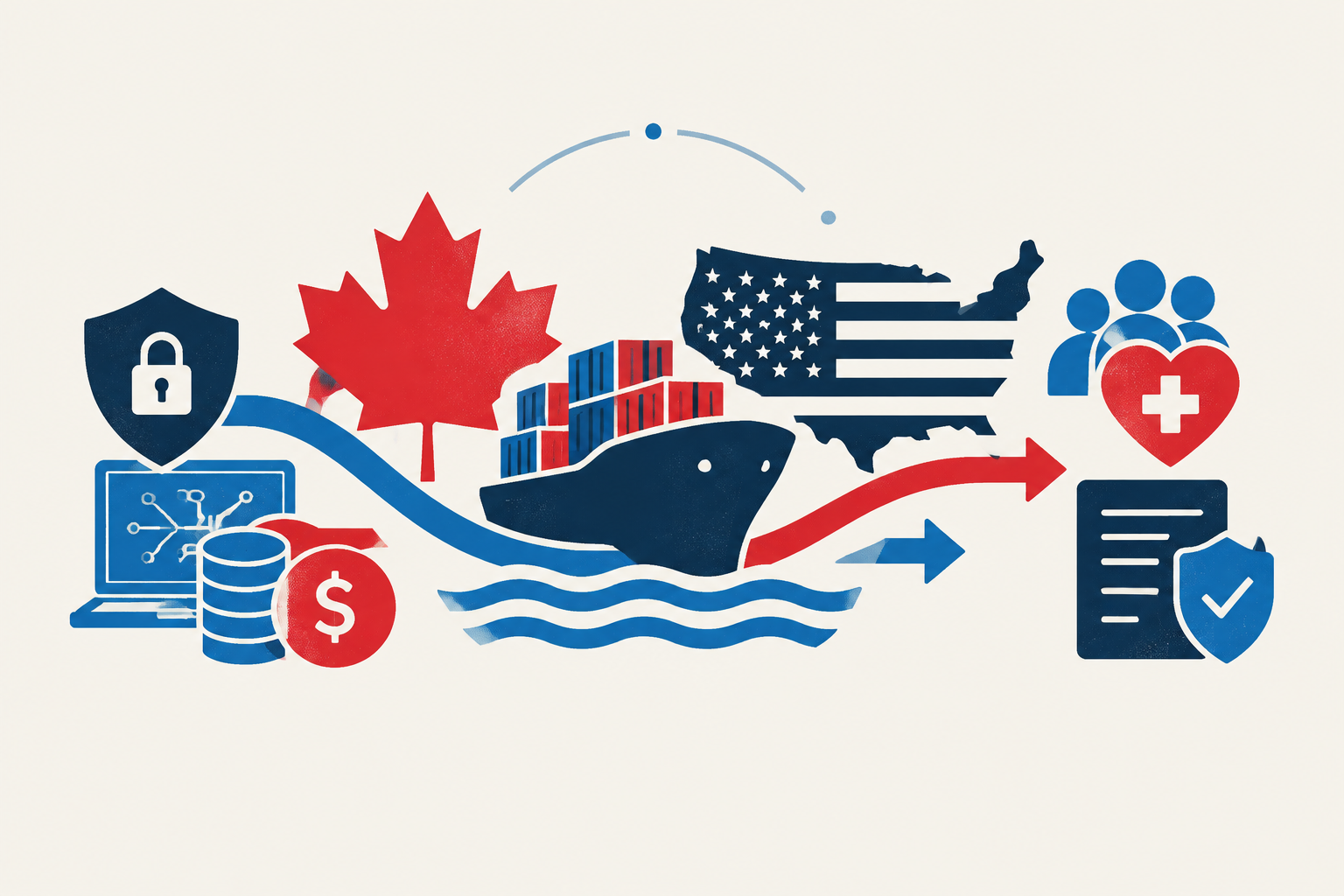
Lockton Canada’s inaugural update urges businesses to reassess insurance, credit and workforce costs as tariff exposure combines with cyber and benefits pressures.
Lockton Canada has released its first Market Update, framing trade disruption, AI-enabled fraud and rising employee-benefit costs as interconnected risks for Canadian companies’ insurance coverage, financial planning and workforce strategies. The brokerage’s central warning is that a shock in one operating area can alter exposures elsewhere, particularly for businesses with manufacturing, wholesale or export activity. [1]
The report places its assessment against a more difficult Canada-U.S. trade setting. It notes that the United States imposed 50 per cent tariffs on $27.6 billion of Canadian goods in late August, followed by Canadian counter-tariffs of 15, 25 and 50 per cent on equivalent-value U.S. imports on September 8. It also points to the U.S. decision not to extend CUSMA for another 16-year term, leaving the agreement in an annual review cycle and shortening companies’ planning horizon. [1]
For insured businesses, the immediate concern is whether policy values still match the cost of replacing inventory after duties. Lockton says property, cargo and business-interruption coverage may be based on pre-tariff replacement values, potentially leaving a company underinsured if it suffers a loss and must buy more costly goods. The report also highlights counterparty exposure: U.S. business bankruptcy filings rose 16.9 per cent in the 12 months to June 30, while Canadian total insolvencies increased 4.9 per cent in the year to July 31, before the late-August tariff escalation. [1]
Cyber risk is presented as a parallel financial and operational challenge. The article cites more than $188 million in fraud losses reported to the Canadian Anti-Fraud Centre in the first quarter of 2026, while noting that the Competition Bureau has estimated only five to 10 per cent of frauds are reported. In a KPMG Canada survey of 251 companies, 81 per cent of respondents that had been defrauded said generative AI was used in the attack, and nearly one-quarter reported voice-cloning calls impersonating an executive. [1]
The update also identifies benefits expenses as another source of pressure. It says high-cost specialty drugs, including GLP-1 therapies, are expected to keep pushing plan costs higher, even as employer coverage expands. Lockton’s cited data also point to employee financial stress and demand for more retirement, pension and savings support, issues that can affect productivity and workforce planning. [1]
For business owners and their advisers, the report’s practical implication is not that these risks have already produced uniform losses across the economy, but that existing assumptions may be outdated. Lockton recommends reviewing tariff-adjusted insurance values, monitoring the credit quality and payment behaviour of customers and suppliers, and checking whether fraud and cyber exposures are adequately reflected in policy structures and financial plans. [1]
This is a moderate-significance business-risk development because Lockton Canada’s new Market Update links tariff exposure to potentially higher inventory replacement costs, counterparty stress and insurance gaps, while also identifying AI-enabled fraud and benefits costs as concurrent burdens. The report is relevant to trade-exposed firms and their advisers, but it is an assessment and risk-management warning rather than evidence of a new tariff action or measured sector-wide deterioration. [1]